Diplomacy: your first turn
Play through one Standard Diplomacy movement phase as France in Spring 1901. You will negotiate, enter three orders, check the deadline, and read the result. This is a teaching position, not a recommended opening: Germany contests Burgundy, and every unit not mentioned below holds.
Your starting position
France starts with armies in Paris and Marseille and a fleet in Brest. An army moves on land; a fleet moves through sea spaces and along coasts. In order notation, A means army and F means fleet. The maps below open focused on France. Choose Show full map to see the rest of the board. These are fixed teaching examples; you can inspect the orders and results without joining a game.
1. Negotiate
Suppose you ask Germany to leave Burgundy empty. That conversation is called press. An agreement is a promise between players, not an enforced order: Germany may still order its Munich army into Burgundy. Decide what you want each French unit to do, and consider what happens if a neighbour chooses differently. In Gunboat games, player-to-player press is unavailable; this example assumes Standard Diplomacy with press.
2. Enter orders
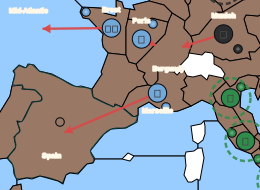
Order A Paris to Burgundy, A Marseille to Spain, and F Brest to Mid-Atlantic Ocean. These are three separate move orders. Select each unit and its destination, then review and submit the orders. A map choice or a saved draft is not itself a submitted order. Check the submitted-order status before leaving.
The orders in this example
These are legal moves from the Standard starting position. All other units hold.
| Power | Unit and starting province | Order |
|---|---|---|
| France | A Paris (PAR) | Move to Burgundy (BUR) |
| France | A Marseille (MAR) | Move to Spain (SPA) |
| France | F Brest (BRE) | Move to Mid-Atlantic Ocean (MAO) |
| Germany | A Munich (MUN) | Move to Burgundy (BUR) |
The German order is shown here to explain the result. You do not see another power's private orders while a Standard movement phase is open.
The orders on the map
3. Check every phase deadline
Use the current phase deadline shown at the table. Movement, retreat and build phases can have different allowances, so check all of them before joining. You can replace submitted orders while the phase is open. On tables that allow early resolution, the phase can close when every required player is ready; fixed-deadline tables wait for the deadline. Do not rely on an extra break before the next phase.
4. Read the simultaneous result
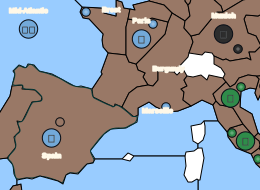
Every order resolves from the same starting position. Paris and Munich both try to enter Burgundy with strength one. Neither has support, so the equal-strength attacks cause a standoff: the French army stays in Paris, the German army stays in Munich, and Burgundy remains empty. France's other orders succeed: the Marseille army moves to Spain and the Brest fleet moves to Mid-Atlantic Ocean.
The position after resolution
5. Plan the next phase
No unit was dislodged, so this example needs no retreat orders and proceeds to Fall 1901 movement. The army in Spain does not earn a new supply centre or a build in Spring: supply-centre ownership is checked after Fall movement. Plan how to keep Spain through that check while protecting France. When another position does produce dislodgements, affected players must handle the retreat phase first. Builds or removals depend on the later supply-centre count and vacant eligible home centres.
Before you choose a table
This walkthrough uses the Standard map and normal visibility. Other maps can change starting positions and connections; Fog of War changes what you can see. Read the variant rules and each phase allowance before joining. The next phase receives its own configured allowance when it starts; return before the deadline shown for your action.
Continue learning
Use a rules reference for your next question, or choose a table when you are ready.
Diplomacy rules
Read the full Standard rules before choosing an opening.
Explore →ReferenceOrders and adjudication
Check support, convoys, retreats and adjustments against the published reference.
Explore →CommunityDiplomacy community guide
Find background reading and places to learn more about Diplomacy.
Explore →PlayFind a Diplomacy game
Review the variant and every phase allowance before joining an open table.
Explore →